

DFMD vs HHMD: 8 Key Differences & Which Metal Detector You Actually Need
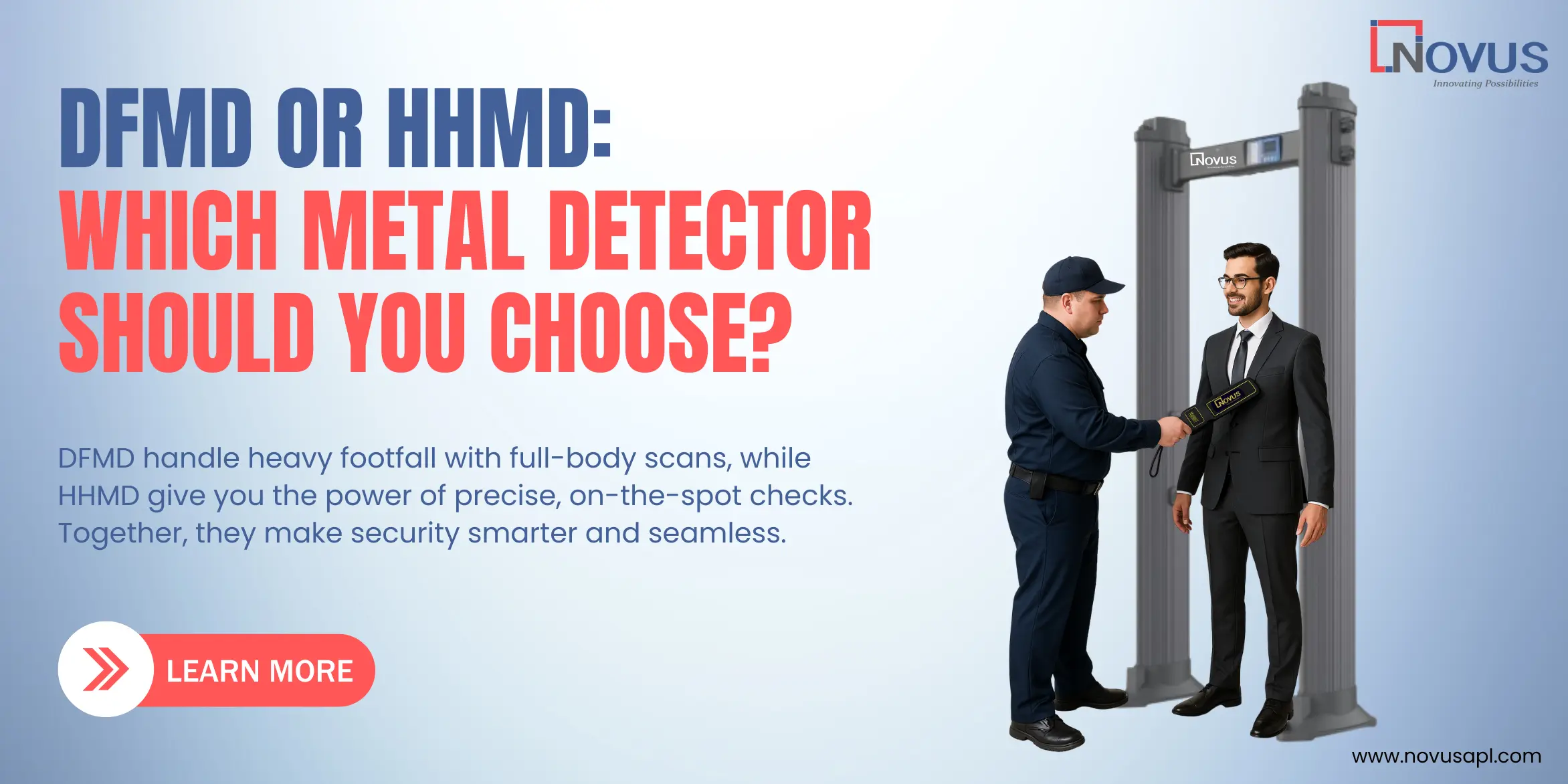
Choose a DFMD (Door Frame Metal Detector) when you need to screen large volumes of people quickly at a fixed entrance — airports, corporate campuses, stadiums, or schools.
Choose an HHMD (Hand Held Metal Detector) when you need portable, flexible screening at lower-traffic locations, as a secondary check, or where installing a full gate is impractical.
Best approach: Use both together — DFMD for the primary lane, HHMD for secondary checks and bag scanning.
Security screening is a non-negotiable for any modern facility — corporate headquarters, schools, event venues, hospitals, and industrial sites. When it comes to metal detection, two technologies dominate: the Door Frame Metal Detector (DFMD) and the Hand Held Metal Detector (HHMD).
But how do you choose? This guide breaks down 8 key differences, real-world use cases, cost comparisons, and expert recommendations — so you make the right call for your facility.
What is a Door Frame Metal Detector (DFMD)?
A Door Frame Metal Detector is a fixed, walk-through security gate consisting of two vertical panels. Every person must physically pass through the frame, which emits a continuous electromagnetic field. When that field is disturbed by a metallic object — a weapon, a blade, or any significant steel item — an alarm triggers.
DFMDs are permanently installed and designed to handle continuous, high-volume throughput with minimal operator involvement.
How a multi-zone DFMD detects metal and localises it to a specific body zone
Key strengths of DFMD
- High throughput: screens hundreds of people per hour without manual scanning
- Multi-zone detection: models range from 1-zone to 33-zone, pinpointing exactly where on the body metal is located
- Strong visual deterrent: a visible gate signals serious security to would-be threats
- Low per-person labour cost: minimal operator involvement per screening
- Consistent screening: no human variability — every person gets the same check
For a deeper technical overview, see our full guide on door frame metal detectors in security systems.
What is a Hand Held Metal Detector (HHMD)?
A Hand Held Metal Detector is a portable, wand-shaped device operated manually by a security officer. The officer sweeps the wand over the person's body or around a bag — the device beeps or vibrates when it senses metal nearby.
HHMDs are widely used as secondary screening tools, at smaller entry points, during random checks, or in locations where installing a full walk-through gate is impractical or unnecessary.
A security officer scans a visitor's body zones manually with an HHMD wand
Key strengths of HHMD
- Fully portable: use anywhere — events, vehicle inspections, bag checks, remote locations
- Zero installation cost: no gate structure, wiring, or floor work required
- Targeted screening: focus precisely on a pocket, bag, or specific body area
- Backup reliability: works as a failsafe when the DFMD alarms and needs follow-up
- Lower upfront cost: accessible for small offices and low-budget deployments
See our comprehensive buyer's guide to hand held metal detectors for model recommendations and buying tips.
What is the difference between DFMD and HHMD?
The core difference between a DFMD and HHMD is how screening happens: a DFMD automatically screens every person passing through a fixed gate using electromagnetic fields, requiring no direct operator contact per person. An HHMD requires a security officer to manually sweep the wand over each individual, making it slower but more flexible.
DFMD is designed for volume and consistency; HHMD is designed for flexibility and targeted use. Most professional security setups deploy both in tandem.
Full comparison: 8 key criteria
| Criterion | DFMD (Door Frame) | HHMD (Hand Held) |
|---|---|---|
| Throughput / Speed | High — entire person screened as they walk through ✓ Winner | Slower — operator scans manually, one person at a time |
| Installation & Infrastructure | Fixed installation — requires gate structure, wiring, stable floor surface | Zero installation — portable, plug-and-charge ✓ Winner |
| Initial Cost | Starting from ₹40,000* per unit (indicative price, varies by zone count) | Starting from ₹5,000* per unit (indicative price) ✓ Winner |
| Ongoing Labour Cost | Low — minimal operator time per person screened ✓ Winner | High — requires dedicated operator per device, per shift |
| Best for High Traffic | Excellent — no bottleneck, continuous flow ✓ Winner | Poor — creates queues when traffic is high |
| Portability & Flexibility | None — fixed after installation | Very high — move anywhere, any time ✓ Winner |
| Visual Deterrent Effect | Strong — visible gate signals serious security ✓ Winner | Weaker — wand is less imposing |
| Space Requirement | Requires a dedicated lane (approx. 1m width) | Minimal — can operate in any space ✓ Winner |
When to choose a DFMD
A DFMD is the right choice when:
✓ Choose DFMD when...
- Footfall exceeds 200+ people per hour at entry
- You need a permanent, unmanned screening lane
- A strong visual deterrent is part of the security strategy
- You want zone-based detection to speed up secondary checks
- The facility has stable infrastructure for installation
- Long-term ROI matters more than upfront cost
Real-world examples
- Tech campus with 3,000+ daily employees
- Sports stadium or concert venue
- Airport domestic terminal entrance
- Government or court building lobby
- Metro station entry gate
- Hospital with high visitor volumes
Pro tip: A tech park with 3,000 employees can screen everyone in under 90 minutes using three DFMD lanes — the same job would take 6+ hours with HHMDs alone. The DFMD pays for itself within 6–12 months in labour savings.
When to choose an HHMD
An HHMD is the right choice when:
✓ Choose HHMD when...
- Traffic volume is low or irregular
- Screening is event-based or mobile
- Space constraints prevent gate installation
- You need a secondary check after a DFMD alarm
- Budget is limited and throughput demands are low
- Random spot-checks are the primary screening method
Real-world examples
- Boutique hotel screening VIP guests
- Small office reception desk
- Outdoor event or festival (mobile security)
- Vehicle inspection at a checkpoint
- Secondary lane at a large venue
- School with limited entry points
Hybrid approach: using DFMD and HHMD together
The most effective security deployments use both technologies in a layered setup. This is standard practice at airports, government buildings, and large corporate campuses worldwide.
In a hybrid setup, the DFMD handles primary volume while HHMDs are reserved for alarm follow-up and secondary lanes. This balances speed, cost, and security depth without sacrificing either.
Cost & ROI breakdown
Understanding the total cost of ownership — not just the sticker price — is critical to making the right choice.
* Prices shown are indicative base prices and may vary depending on zone configuration, optional features, order quantity, and prevailing market conditions. Contact us for a confirmed quote.
Beyond purchase price, factor in:
- Labour cost: a DFMD requires ~1 operator per lane; an HHMD requires ~1 operator per 30–60 visitors screened
- Installation cost: DFMD requires electrician and floor preparation (₹5,000–₹25,000 additional); HHMD has zero installation cost
- Maintenance: both require quarterly calibration checks; DFMD may need annual servicing
- ROI timeline: at facilities with 500+ daily visitors, a DFMD typically pays back its cost within 12–18 months in labour savings alone
Common mistake: facilities choose HHMD because of the lower price — then spend 3× more on security labour within the first year. Always calculate 3-year total cost of ownership before deciding.
Future trends in metal detection technology
Both DFMD and HHMD technologies are evolving rapidly. Key trends to plan for:
- AI-powered false-alarm reduction: next-generation DFMDs use machine learning to distinguish benign metal (keys, belts, phones) from genuine threats, reducing false alarms by up to 60%
- IoT connectivity: modern detectors send real-time alerts, logs, and diagnostic data to a central security dashboard — enabling remote monitoring across multiple sites
- Multi-threat screening: newer units combine metal detection with millimetre-wave sensing to detect non-metallic threats like ceramic blades or plastic components
- Miniaturised HHMD with Bluetooth: wireless HHMDs now sync alert data to mobile apps and security control rooms in real time
- People counting integration: DFMDs are increasingly paired with crowd analytics to report throughput data alongside security logs
When purchasing today, prioritise devices with software upgrade paths so you can adopt these capabilities without hardware replacement.
For technical reference on walk-through metal detection standards, see Rapiscan Systems' metal detection technology overview.
Frequently asked questions
What is the difference between DFMD and HHMD?
A DFMD (Door Frame Metal Detector) is a fixed walk-through gate that automatically screens every person passing through using electromagnetic fields — no direct operator contact needed per person. An HHMD (Hand Held Metal Detector) is a portable wand that a security officer manually sweeps over individuals. DFMDs are faster and better for high-traffic venues; HHMDs are flexible and ideal for secondary checks, smaller locations, or mobile deployment.
What is the full form of HHMD?
HHMD stands for Hand Held Metal Detector. It is a portable, wand-shaped security scanning device used by security personnel to detect metal objects on a person's body or in their belongings by manually sweeping the device over them.
What is the full form of DFMD?
DFMD stands for Door Frame Metal Detector. It is a fixed, walk-through security gate installed at entry and exit points to automatically detect concealed metallic objects as people pass through the frame. Commonly installed at airports, metro stations, courts, factories, and corporate buildings.
Which is better for high-traffic venues — DFMD or HHMD?
DFMD is significantly better for high-traffic venues. A walk-through DFMD can screen hundreds of people per hour with minimal manual involvement. An HHMD requires an operator to scan each person individually, creating bottlenecks at busy entry points. For venues with 200+ visitors per hour, DFMD is the professional standard.
Can HHMD replace DFMD in large venues?
No — in large, high-traffic venues, an HHMD cannot effectively replace a DFMD. HHMDs work well as secondary checks or at lower-traffic points. For primary screening at large venues, DFMDs are the recommended solution. Most security professionals deploy both together for layered protection.
How many zones does a DFMD have?
DFMDs are available in various zone configurations. Common options include 1-zone, 6-zone, 9-zone, 18-zone, and 33-zone models. More zones allow greater precision in pinpointing the exact body location of a detected metal object, which speeds up the secondary check process. Novus Automation offers models from 9-zone up to 33-zone.
What is the cost difference between DFMD and HHMD?
HHMDs are significantly cheaper upfront — starting from ₹5,000* per unit (indicative price). DFMDs start from ₹40,000* per unit (indicative price), with higher-zone models priced accordingly. However, at high-traffic facilities, the DFMD reduces labour costs so significantly that it usually delivers a positive ROI within 12–18 months. Always calculate 3-year total cost of ownership before deciding on price alone. *Prices are indicative and may vary based on specifications, quantity, and market conditions.
Can metal detectors detect non-metal threats like explosives or liquids?
No. Both DFMD and HHMD detect metallic objects only. For non-metallic threats — plastic explosives, liquids, ceramics, organic materials — you need additional screening technologies such as X-ray baggage scanners, millimetre-wave body scanners, or explosive trace detectors. Most high-security deployments combine metal detectors with X-ray systems for comprehensive coverage.
Does an HHMD require much operator training?
Yes — effective HHMD use requires training. Operators must learn the correct sweep technique (speed, distance, body zone coverage), how to interpret alert signals, and how to conduct a secondary check professionally without causing discomfort or complaints. Untrained HHMD operation can miss threats or create unnecessary friction at entry points.
Can I use DFMD and HHMD together in the same facility?
Absolutely — this is the recommended approach for most medium-to-large facilities. Use the DFMD for primary screening at the main entrance, and deploy HHMD units for secondary checks when the DFMD alarms, for screening at additional entry points, and for bag/parcel scanning. This layered approach maximises both speed and accuracy.