

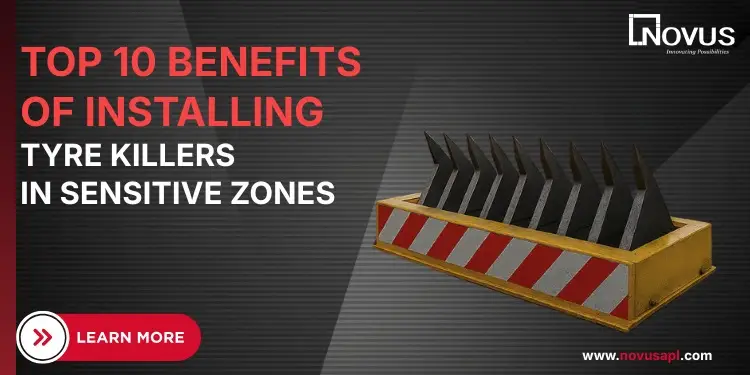
1)Top 10 Benefits of Installing Tyre Killers in Sensitive Zones
3)Top 10 Benefits of Tyre Killer Installation
4)Why Tyre Killers Are Essential for Sensitive Zones
In an era of heightened security concerns, protecting sensitive zones like defense facilities, embassies, data centers, and industrial plants has become a top priority. While boom barriers and bollards manage routine access, certain sites demand stronger deterrence against forced entry. This is where tyre killers come in — a powerful, high-impact solution that ensures complete vehicle immobilization during unauthorized entry attempts.
The benefits of tyre killer systems go beyond stopping vehicles; they form a critical layer in perimeter defense strategies. Designed for speed, precision, and durability, tyre killers like those by Novus Automation Pvt. Ltd. combine 2.8-meter coverage, rapid 2–3 second operation, and robust hydraulic control to deliver unmatched performance in high-threat environments.
A tyre killer is an automated, heavy-duty security system designed to puncture the tyres of unauthorized vehicles attempting to breach controlled access points. The system consists of a series of sharp steel spikes that rise from the ground at an angle (typically 60°), creating an impassable barrier.
These specifications make it a reliable security measure for defense zones, government installations, airports, and critical infrastructure facilities.
The primary benefit of a tyre killer is its ability to instantly disable unauthorized vehicles. The sharp, high-strength steel spikes puncture tyres and halt the vehicle within meters, preventing intrusion even under high-speed attempts.
Even before activation, visible tyre killer spikes serve as a psychological deterrent. The sight of heavy steel teeth at an entry point sends a clear message — only authorized access is permitted.
Novus tyre killers operate with a 2–3 second rise and lower time, allowing security personnel to control traffic efficiently. The system responds rapidly to access commands while maintaining safety integrity.
Security cannot stop during a power outage. Novus tyre killers include an emergency hand pump built into the control cabinet, ensuring uninterrupted functionality during electrical failures or maintenance.
Unlike older models, modern hydraulic tyre killers feature dual safety loops. These sensors prevent the spikes from rising when a vehicle is above the platform, eliminating accidental tyre damage and ensuring safe operation.
Constructed from high-tensile steel and corrosion-resistant coatings, tyre killers withstand extreme weather, dust, and repeated mechanical stress. This design ensures longevity, even under heavy daily usage in outdoor environments.
Tyre killers can be synchronized with boom barriers, RFID systems, card readers, and surveillance cameras, creating a unified security solution. When integrated, they allow fully automated entry management at high-security facilities.
For sensitive areas like airbases, ports, or industrial plants, tyre killers help segregate entry lanes, ensuring vehicles pass only through verified access routes. This eliminates traffic confusion and enforces compliance with security protocols.
Thanks to hydraulic drive systems and simple mechanical structures, tyre killers require minimal upkeep. Routine inspections and lubrication ensure years of stable performance, reducing total ownership cost.
Modern government and defense tenders now specify tyre killers as a mandatory component in vehicle security checkpoints. Installing a compliant Novus system ensures your facility meets these evolving safety and regulatory standards.
Sensitive zones are defined by their need for layered security — where human access control alone isn’t sufficient. A tyre killer acts as an active barrier, not just a passive one. Whether it’s stopping a speeding vehicle or protecting an entry gate from forced intrusion, these systems provide a physical and psychological advantage over other security options.
They are especially critical in:
When paired with automatic boom barriers and anti-terrorism bollards, they create a multi-layered perimeter defense system — an essential requirement for any high-risk facility.
Installing a tyre killer requires expert alignment and calibration to ensure safety and performance. The standard installation process includes:
With Novus’s engineering support, installation typically completes within a few hours and ensures compliance with all operational safety standards.
While tyre killers represent a higher initial investment than basic barriers, the long-term benefits outweigh the cost. When factored into the total security infrastructure:
The system delivers excellent return on security investment (ROSI) — both in protection value and deterrence capability.
The future points toward IoT-enabled, sensor-driven tyre killers with automated diagnostics and integration into centralized command systems. Predictive maintenance, AI-based traffic analysis, and solar-powered control units are emerging trends.
Novus Automation continues to innovate in this space — designing high-speed, low-noise, and weatherproof systems optimized for Indian operational environments.
For further reading on vehicle barrier systems and their evolution, see Wikipedia’s article on Road Traffic Control Devices.
Tyre killers provide high-security vehicle immobilization, fast response, and strong deterrence against forced entries in restricted areas.
Most models, including Novus NS-TKS10-H280, operate within 2–3 seconds, ensuring minimal disruption to authorized traffic.
Yes. They integrate seamlessly with boom barriers, RFID readers, and vehicle detection loops for automated control.
Yes. Built with corrosion-resistant materials, they perform reliably in heat, rain, and dust-heavy environments.
Novus systems include an emergency hand pump, allowing manual operation during power outages.
No. Dual loop sensors ensure spikes retract when a vehicle is above the system, preventing accidental tyre puncture.
Typically, 380V AC is used to power the hydraulic control cabinet.
They are used in defense zones, government offices, airports, and corporate entry gates where vehicle control is critical.
With preventive maintenance, systems can perform reliably for 8–10 years or longer.
Because Novus combines precision engineering, high safety standards, and local manufacturing support to deliver durable, future-ready solutions.
Secure your critical facility with advanced vehicle control technology. Contact Novus Automation Pvt. Ltd. today to learn more about our Tyre Killer Systems and how they can strengthen your access control infrastructure.
Visit www.novusapl.com or call +91-7290044421 for consultation and site assessment.

Accelerate Your Business with Novus Automation
Become a Partner