

4)Methodology: How Performance Was Evaluated
5)Observation 1: Traffic Load Matters More Than Climate Alone
6)Observation 2: Ultra-Fast Systems Are Not Universally Superior
7)Observation 3: Predictable Traffic Reduces Environmental Impact
8)Observation 4: Cold Regions Prioritize Consistency Over Performance
9)Pattern Mapping: Traffic vs Environment
10) What “All-Weather” Means in Practice
Electronic boom barriers are often evaluated in controlled, urban environments. But their real test begins in climate-stressed regions, where temperature extremes, dust, moisture, and limited maintenance access expose long-term design weaknesses.
To understand what actually determines reliability, this field study examines real electronic boom barrier deployments across India’s harshest terrains — from the sub-zero altitudes of Leh–Ladakh to the desert cantonments of Jaisalmer and Nasirabad.
This article documents patterns observed in the field, not theoretical performance.
This analysis is based on operational boom barrier deployments in:
The systems evaluated:
This is not a laboratory comparison and does not rely on simulated conditions.
Instead of focusing on isolated specifications such as speed or motor type, the evaluation considered:
The goal was to identify repeatable patterns, not individual exceptions.
Environmental stress factors such as temperature variation, dust exposure, and long-term durability considerations are consistent with infrastructure reliability principles outlined by the Bureau of Indian Standards (BIS).
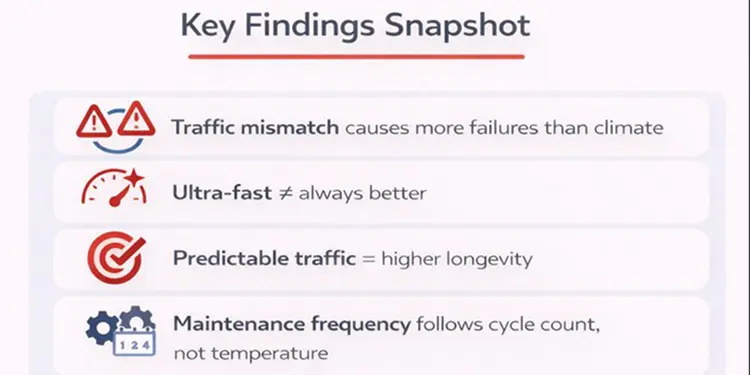
Across all terrains, climate stress amplified weaknesses — but it rarely caused failure on its own.
Failures occurred most often when:
In both cold and desert regions, correctly traffic-matched systems demonstrated stable performance, even under harsh weather conditions.
Ultra-fast boom barrier systems performed best in:
However, in sites with:
Moderate-speed systems often exhibited lower cumulative wear and more predictable maintenance cycles.
Speed proved to be an advantage only when traffic justified it.
In desert cantonment zones such as Jaisalmer and Nasirabad, traffic was continuous but highly predictable.
In these environments:
This indicates that traffic regularity mitigates environmental stress more effectively than higher specifications.
High-altitude installations such as Leh–Ladakh present a different challenge profile:
Field insight:
Cold starts were a bigger concern than opening speed in Ladakh.
Systems that prioritized controlled, predictable operation under realistic traffic loads demonstrated greater long-term reliability than those optimized primarily for speed.
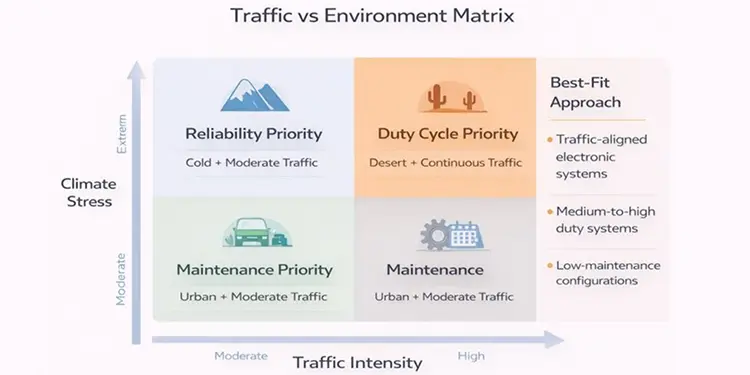
| Environment Type | Traffic Pattern | Observed Best-Fit Approach |
|---|---|---|
| High-altitude cold | Moderate, intermittent | Traffic-aligned electronic systems |
| Desert cantonment | Continuous, predictable | Medium-to-high duty systems |
| Mountain & rain | Moderate, mixed | Weather-resistant, stable systems |
| Urban parking | Daily, moderate | Low-maintenance configurations |
This reinforces a central conclusion:
Environment determines stress, but traffic determines survival.
Field observations show that “all-weather” capability does not mean immunity from climate.
In practice, it means:
In extreme terrains, predictability is reliability.
This analysis highlights several planning implications:
Selecting the right electronic boom barrier system depends on aligning traffic intensity, environment, and operational expectations — not choosing the highest specification available.
No. Ultra-fast systems are effective only when traffic volume and operational urgency justify them.
Traffic mismatch, compounded by environmental stress.
Usage. Climate introduces stress, but traffic intensity determines long-term reliability.
Extreme terrains do not reward maximum specifications.
They reward correct system alignment.
From the frozen altitudes of Leh–Ladakh to the desert heat of Jaisalmer, real-world deployments show that all-weather electronic boom barrier systems succeed when traffic demand, environment, and system design are aligned from the start.
Accelerate Your Business with Novus Automation
Become a Partner