


1) Tripod Turnstile Gate: What It Is, How It Works & Real-World Use Cases
2) What Is a Tripod Turnstile Gate?
3) How Does a Tripod Turnstile Gate Work?
4) Types of Tripod Turnstile Gate Systems
5) Materials, Build Quality & Longevity
6)Real-World Use Cases of Tripod Turnstile Gates
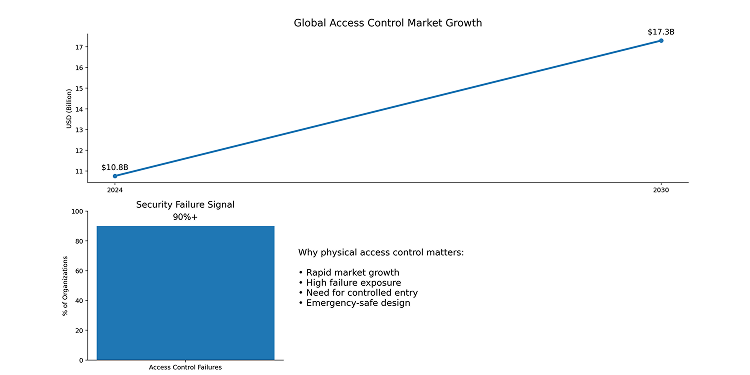
Security infrastructure rarely gets attention—until it fails.
Every day, thousands of people pass through offices, factories, metro stations, and stadiums. What quietly controls who enters, who doesn’t, and how smoothly crowds move is often a tripod turnstile gate.
A tripod turnstile gate is not just a physical barrier. It’s a system designed to enforce discipline, prevent tailgating, and create accountability—without slowing people down. In this guide, we explain what a tripod turnstile gate is, how a tripod turnstile gate works, the types of tripod turnstile gate systems available, and where they are used in the real world.
A tripod turnstile gate is a waist-high pedestrian access control device that allows only one person per authorization cycle.
It features three rotating arms arranged in a tripod formation. When valid access is granted—via RFID card, biometric reader, QR code, or ticket—the tripod turnstile gate unlocks briefly, allowing a single 120° rotation.
The purpose of a tripod turnstile gate is simple but powerful:
Because of this balance between simplicity and control, the tripod turnstile gate remains one of the most deployed access control solutions worldwide.
Understanding how a tripod turnstile gate works helps clarify why it’s so reliable.
1. Default Locked State
The tripod turnstile gate remains locked, blocking movement from both directions.
2. User Authentication
Access is requested using:
3. Access Verification
The controller validates credentials against predefined rules.
4. Controlled Rotation
Once approved, the tripod turnstile gate releases its lock and allows one controlled 120° rotation—enough for a single person.
5. Automatic Relocking
After passage, the tripod turnstile gate locks again instantly.
Emergency Operation
In fail-safe or drop-arm variants, the arms of the tripod turnstile gate drop automatically during power failure or fire alarms to allow free exit.
Not every tripod turnstile gate is built for the same environment.
Manual Tripod Turnstile Gate
Best for: stadiums, public crowd control, temporary installations
Best for: offices, factories, educational institutions
Best for:metro stations, airports, corporate headquarters
Best for: IT parks, government buildings, high-occupancy zones
A commercial-grade tripod turnstile gate is engineered for heavy daily use.
Typical construction includes:
According to access control fundamentals outlined by ASIS International and public safety guidelines referenced by NFPA, physical barriers combined with electronic authentication significantly improve perimeter security reliability.
Corporate Offices & IT Parks
Tripod turnstile gates integrate with attendance and HR systems, preventing buddy punching and unauthorized entry.
Factories & Industrial Plants
Tripod turnstile gate systems manage shift-based labor, contractors, and restricted zones efficiently.
Metro Stations & Transit Hubs
High-speed validation and one-person-per-entry enforcement make tripod turnstile gates ideal for mass transit.
Stadiums & Event Venues
Portable and fixed tripod turnstile gate units regulate crowd flow while reducing manpower.
Educational Institutions
Tripod turnstile gates improve campus security and monitor student movement
Hospitals & Government Buildings
Controlled visitor access with emergency-safe exit options.
Despite advances in access technology, a tripod turnstile gate offers:
A tripod turnstile works by locking its arms by default and allowing a single controlled rotation after successful access authentication.
In access control, a tripod is used to regulate pedestrian entry, prevent tailgating, and ensure one-person-per-entry enforcement.
The purpose of a turnstile is to control, monitor, and secure pedestrian movement while maintaining smooth flow.
The term comes from the rotating “stile” arms that turn to allow passage, similar to historical farm stiles.
No. A well-built tripod turnstile gate requires minimal maintenance, mainly periodic lubrication and electrical checks.
A tripod turnstile gate may appear simple, but it delivers structured security at scale. When selected correctly, it becomes invisible infrastructure—quietly enforcing order every single day.
Accelerate Your Business with Novus Automation
Become a Partner